1 Open the list
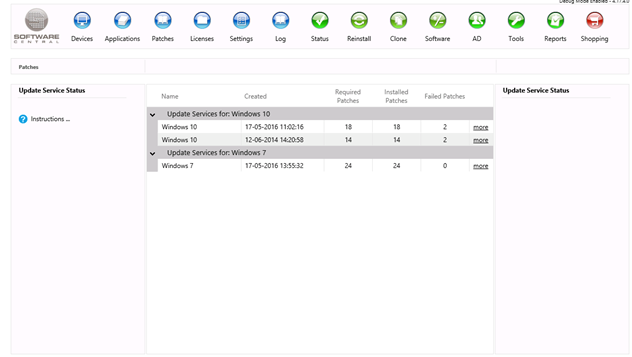
Open the Patches menu in the top bar to see the Update Service Status interface.
The list shows the update services that have been deployed to a target collection. It is grouped by update service, under the heading Update Services for and the name of the update service. Use the Select site box in the top bar to choose the site.
This page is the view of the target collections. Approve Update Service is the view of the test collection, where an update service waits for approval before it is sent to the target collection.
2 Read the counts and buttons
Each row gives the name and creation time of the update service, three counts for its patches, and a more link.
| Column | What it tells you |
|---|---|
| Name | The update service. The rows are grouped under a heading, Update Services for, followed by the name of the update service. |
| Created | When the update service was created. |
| Required Patches | How many patches in the deployment are required by the client. |
| Installed Patches | How many of the patches are installed. |
| Failed Count | How many of the patches have failed to install. |
| more | Opens the details window of the deployment. See Details of a deployment. |
3 Details of a deployment
Click more on a row. A new window, Update Service Details, opens with a chart of the deployment.
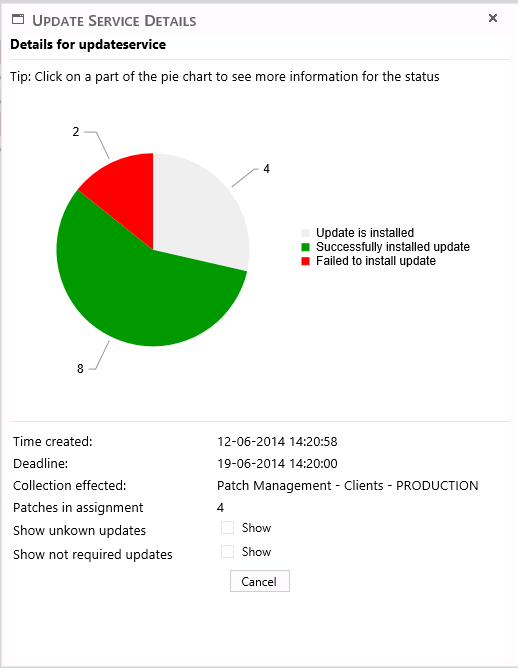
The chart shows how many patches are in each status. Under the chart the window shows the deployment information:
| Field | What it shows |
|---|---|
| Time created | When the update service was created. |
| Deadline | The deadline of the deployment. |
| Collection effected | The target collection that the deployment affects. |
| Patches in assignment | How many patches the update service contains. |
By default the chart shows the installed and the failed patches. Patches whose status is unknown, and patches that are not required, are left out. To add them, tick the checkboxes under the chart:
| Checkbox | What it adds to the chart |
|---|---|
| Show unkown updates | Patches whose status is unknown. The label is spelled this way in the product. |
| Show not required updates | Patches that are not required on the clients. |
Click Cancel to close the window.
4 Status of the patches
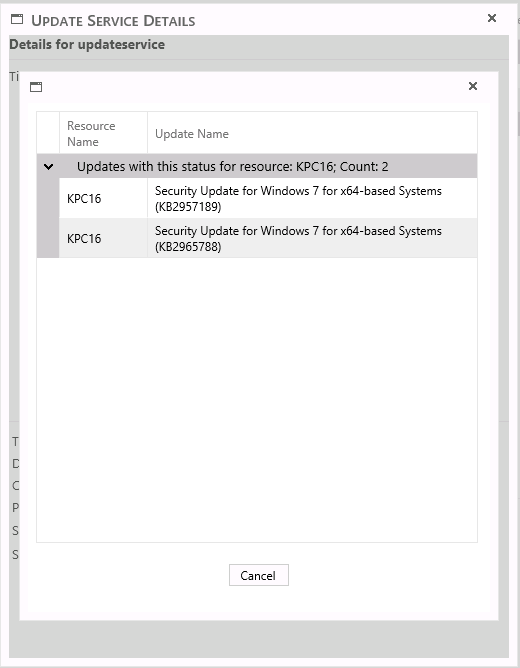
Click a part of the chart to see which computers and patches have that status.
A second window opens. It lists the updates with that status, grouped by computer, with the columns Resource Name and Update Name. Each group heading gives the computer and the number of updates in that status.
5 Best practice
- Look at the Failed Count first. A failed install on a target collection needs action on the computers listed in the status window.
- Read the chart as it opens. Tick Show unkown updates or Show not required updates only when you need to see why a patch is missing from the chart. The chart leaves them out by default.
- Do not read an x as zero. The count is missing, so reload the page before you draw a conclusion from it.
- Sign in again if a new update service is missing. The list is kept for your web session, so a new deployment may not appear until the session is renewed.
6 Troubleshooting
| Symptom | Cause | What to do |
|---|---|---|
| The list is empty, with the text No updates have to be approved | No update service has been deployed to a target collection yet. | Approve the update service in Approve Update Service. It appears here once it has been deployed to the target collection. |
| A count shows x | No count was found for that update service. | Reload the page. If the x stays, look for the error in the SoftwareCentral Log. |
| The status window shows No updates to show. | No patch on the selected computer has that status. | Click another part of the chart, or tick Show unkown updates or Show not required updates. |
| The page shows The requested file does not exist or you do not have access to it. | Your role does not have access to the Patch Management module. | Ask your administrator to check your role. See Oops - Something Went Wrong for the other messages of the error page. |